
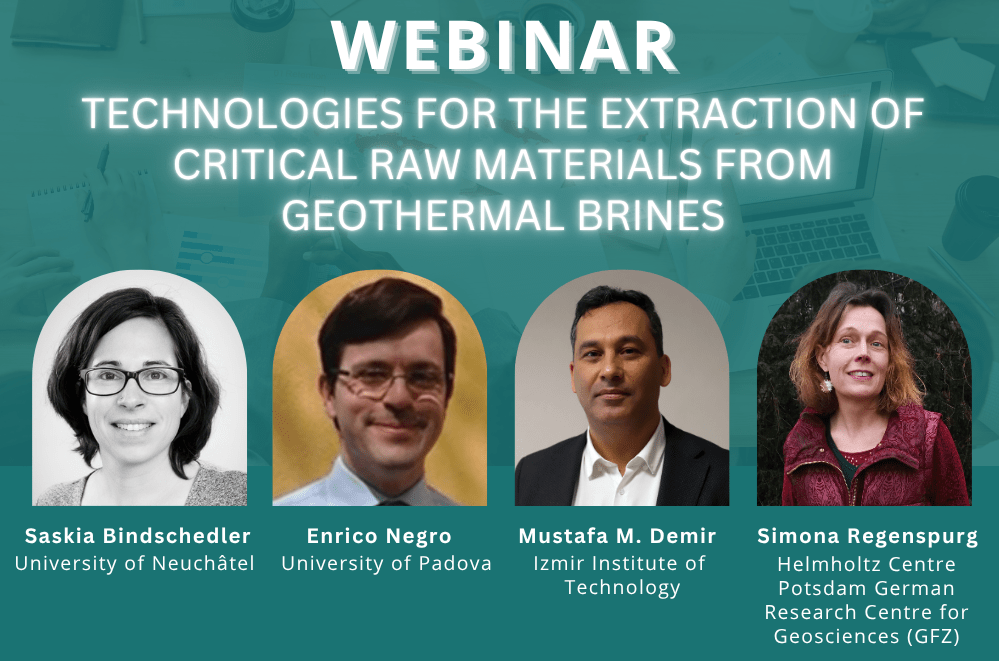
We are pleased to invite you to the webinar “Technologies for the Extraction of Critical Raw Materials from Geothermal Brines”. This event will bring together leading researchers and experts from the CRM-geothermal project to discuss the development of technologies for the recovery of lithium and other critical raw materials from geothermal fluids. As the demand for critical minerals continues to grow due to the global energy transition and the expansion of battery technologies, geothermal brines are increasingly being recognised as a promising and sustainable resource.
Date: 29 June 2026
Time: 14:00 – 15:30 CEST
Agenda & Presentations
- 14:00-14:05 – Welcome by moderator
- 14:05-14:20 – CRM-geothermal Introduction by Simona Regenspurg (10 minutes presentation, 5 minutes Q&A)
- 14:20-14:40 – Extracting Raw Materials (Lithium) from Geothermal Fluid: Opportunities and Challenges by Mustafa M. Demir (15 minutes presentation, 5 minutes Q&A)
- 14:40-15:00 – An Innovative Multistage Approach for the Selective Extraction of Lithium from Geothermal Brines as Battery-Grade Li₃PO₄ by Enrico Negro (15 minutes presentation, 5 minutes Q&A)
- 15:00-15:20 – Using microbes to extract Lithium from geothermal brines by Saskia Bindschedler (15 minutes presentation, 5 minutes Q&A)
- 15:20-15:30 – Final round of Q&A
Speakers
- Dr Simona Regenspurg
Prof. Simona has been working as a research associate at Helmholtz Centre Potsdam German Research Centre for Geosciences in the Section Geoenergy since 2009. She is head of the working group “Geothermal Fluids”. The focus of her research is on the study of geochemical processes that take place during the operation of geothermal plants. These include reactions under increased pressure and temperature conditions, interactions between water and rock and their effects on the environment. Simona studied geology/hydrogeology at Ludwig-Maximilians-Universität in Munich, Germany, and completed research stays in the USA (Colorado School of Mines, Golden), Sweden (Royal University of Technology (KTH), Stockholm) and Switzerland (Ecole Polytechnique Fédérale de Lausanne, EPFL). She is habilitated and teaches at the Free University of Berlin.
- Mustafa M. Demir:
Prof. Mustafa M. Demir received his BS from the Chemistry Department of the Boğaziçi University (Turkey) in 1999.
He did his MS and PhD studies in the Materials Sciences and Engineering Programme at Sabancı University in 2001 and 2004, respectively. He completed his postdoc at the Max Planck Polymer Research Institute in Mainz, Germany. Since 2007, he has been serving as a Professor at Izmir Institute of Technology, Turkey. He has over 110 publications in peer-reviewed journals. His main research interests are nanostructured materials, polymer-based nanomaterials, and polymers in geothermal energy applications.
He was awarded the “Young researcher” Prize of the Turkish Academy of Sciences in 2013.
- Enrico Negro:
Prof. Enrico Negro is an Associate Professor of Chemistry for the Technologies in the Department of Industrial Engineering of the University of Padova, Italy. Since 2005, Prof. Enrico Negro has carried out his research activities in the group “Chemistry of the Materials for the Metamorphosis and Storage of Electrochemical Energy – CheMaMSE”. The research activity of Prof. Enrico Negro is focused on the various functional components adopted in the fabrication of electrochemical energy conversion and storage devices, with a particular reference to ion-exchange materials and electrocatalysts. The expertise of Prof. Enrico Negro covers the value chain from the synthesis of the functional materials and spans to their physicochemical and electrochemical characterisation. Finally, the functional materials are used in the fabrication of prototype devices that are tested for performance and durability. Prof. Enrico Negro is the author or co-author of more than 125 papers and 10 patents. His h-index is 42, having attracted more than 4900 citations (Scopus).
- Saskia Bindschedler:
Saskia Bindschedler is a group leader at the Laboratory of Microbiology of the University of Neuchâtel (LAMUN) directed by Pilar Junier. At the LAMUN, the team studies microbial interactions in various environments, including geothermal ones. There, they focus on microbe-metal interaction and try to explore nature-based approaches for the biorecovery of valuable elements from non-conventional sources.
Registrations are now closed.
